
Case Study 07 / 19
A 1902 sweet shop’s counter, taken online.
Sweet maker in Shimla since 1902.
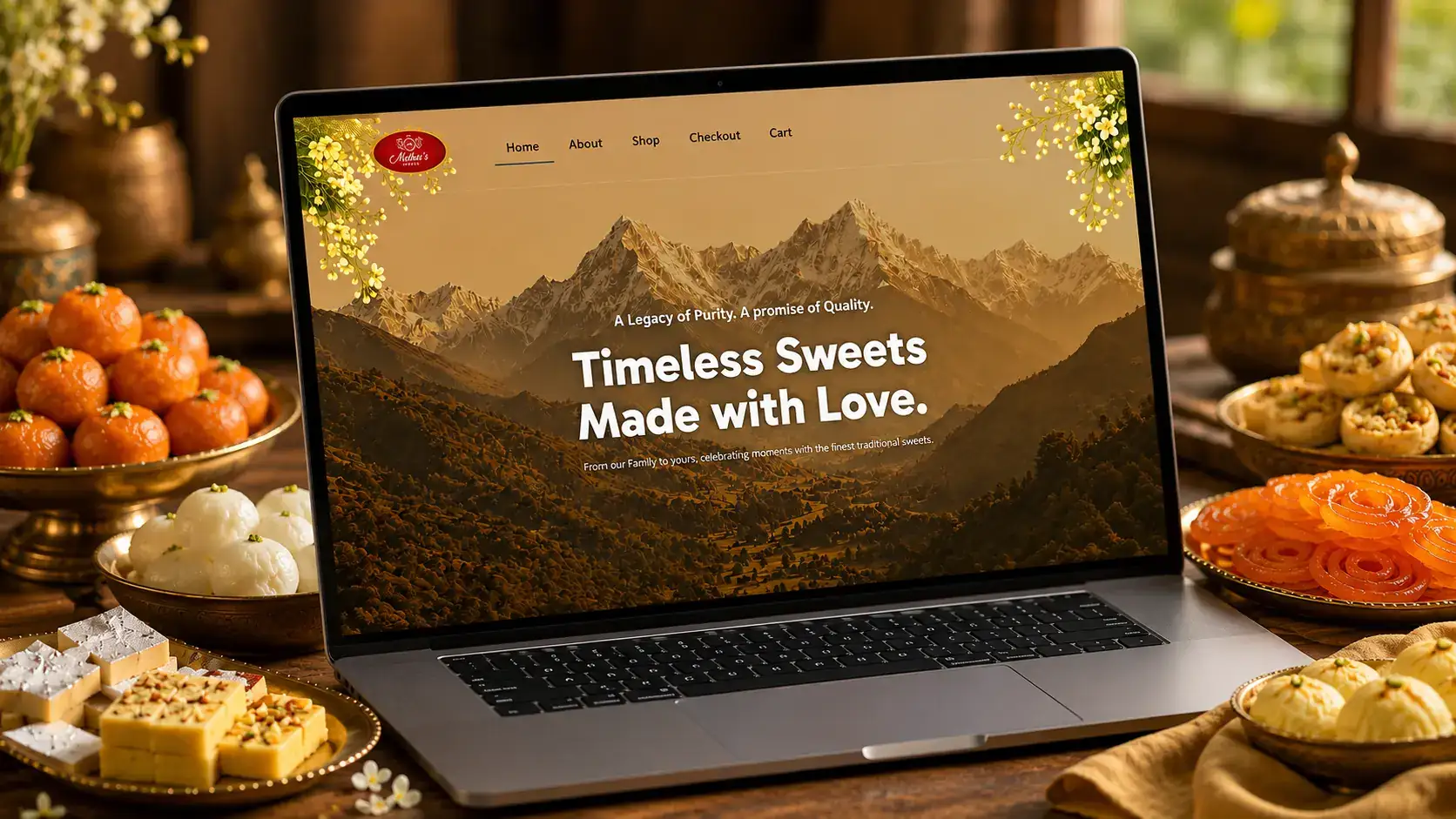
Explore the ProjectAboutMehru’s has made jalebi and traditional sweets in Shimla’s Lower Bazar since 1902. Ishwra developed its website, an online shop where eleven sweets each have a page and a price, set beside the story of the family that makes them, and handles its social media marketing, so the shop and the feed look and sound the same.
- Client
- Mehru’s Sweets
- Industry
- Sweets & confectionery
- Role
- Website development & social media marketing
- Platform
- WordPress, Elementor, WooCommerce
Project overview
Client, scope and responsibilities.
- Client
- Mehru’s Sweets
- Location
- Lower Bazar, Shimla, Himachal Pradesh
- Industry
- Sweets and confectionery
- Our role
- Website development and social media marketing
- Platform
- WordPress, Elementor and WooCommerce
About Mehru’s
Mehru’s is a family sweet maker in Shimla. By the shop’s own account, Lala Meharchand Ji opened it in Lower Bazar in 1902, and each generation since has kept the recipes as they were.
It is known for jalebi and for sweets made with desi ghee and fresh milk: barfi, patisa, pinni, panjiri. The shop is open seven days a week.
A business like this already has what most online shops spend years trying to earn: a name people trust. The website’s job was to carry that name onto a screen without flattening it.
The challenge
Selling by the box without losing the shop.
A counter sells by sight and by trust
At the counter you see the tray, you know the family, and you point. A website has neither the tray nor the shopkeeper. Each sweet has to be clear enough on a screen to choose, with a price beside it.
The story is part of the product
People buy from Mehru’s partly because of how long it has been there. A shop page alone would sell sweets from anyone. The history had to sit close to the catalogue, in a voice that sounds like the shop.
Objectives & strategy
What the site needed to do, and how we approached it.
What the site needed to do
- Give every sweet a page with a price and a way to buy it.
- Keep the path from choosing a sweet to paying for it short.
- Tell the shop’s story in its own voice.
- Let the range and the prices change without a rebuild.
- Carry the same look and voice into social media, so people who find the shop there recognise it on the website.
Our approach
The catalogue comes first
All eleven sweets appear on the homepage with their prices and an add-to-cart button. A visitor who already knows what they want can add it to the cart straight from the first page.
A shop the family can run
We built the site on WordPress with WooCommerce, with pages laid out in Elementor. A new sweet is a new product entry, and a price change is one field. Neither is a design job.
The story in the shop’s own voice
The homepage is in English. The About page is written in Hindi in Roman script, the way the shop’s customers speak and type. It opens with the line “124 saal purani mithai ki dukaan” and reads like the shopkeeper telling it.
Social media in the same voice
We handle the shop’s social media marketing alongside the website. The two are planned together, so the brand looks and sounds the same wherever a customer meets it, and posts can point straight to a sweet’s own page.
What we delivered
Six parts of the shop, and why each matters.
Home pageA homepage that sells from the first scroll
The page opens with the shop’s promise, “A Legacy of Purity, A Promise of Quality”, and five short reasons to trust the kitchen. The full range follows, priced and ready to add to the cart. Sections on gifting and on visiting the shop come after the sweets, not before them.
Site › product › kaju-katliA page for every sweet
Each of the eleven sweets has its own page: name, price, a quantity box, an add-to-cart button and a description of what it is made from. Related sweets from the same shelf sit underneath, the way a shopkeeper points to the next tray. There is room for customer reviews.
Site › product-category › barfiFour shelves to browse
The range is sorted into Barfi, Ladoos, Healthy & Nutritious and Premium Sweets. Each shelf has its own page with a short introduction, a count of what is on it and five ways to sort, including by price. A sweet can sit on more than one shelf.
Site › shopThe whole range on one page
The shop page lists every sweet with its price and an add-to-cart button. Eleven items fit on one page, so there is nothing to page through and nothing hidden behind a filter.
Site › aboutThe story, told the way the shop tells it
The About page gives the founding in Lower Bazar, the founder’s name and the family’s account of keeping the recipes unchanged. The homepage links to it from a “Since 1902” block, so the history is one tap from the catalogue.
Site › cart, checkout, my-accountCart, checkout and the housekeeping behind them
Cart, checkout and account pages complete the path to an order. Four policy pages cover privacy, terms, cookies and a disclaimer. A sitemap lists every page, sweet and shelf, and search engines are told to skip cart links.
Social media marketing
Alongside the shop, we run Mehru’s social media marketing: the sweets, the shop and its story presented in the same look and voice as the website, with each post able to send people to the sweet it shows.
The rate list, online
In the shop, the rate list hangs behind the counter. On the website, every line of it is a page you can buy from.
- PanjiriHealthy & Nutritious₹1,100
- Kaju KatliBarfi₹1,100
- MehsuPremium Sweets₹500
- Sohan HalwaPremium Sweets₹650
- Desi Ghee PatisaPremium Sweets₹650
- Dhodha BarfiBarfi₹650
- Pure Coconut BarfiBarfi₹550
- Anjeer BarfiBarfi, Premium₹650
- Daal PinniHealthy & Nutritious₹650
- Gari Panjiri LaddoosLadoos₹600
- Milk CakeBarfi₹650
Names, prices and shelves as listed on the shop in October 2026.
The website experience
You can buy from the first page
A returning customer who wants Kaju Katli finds it on the homepage, priced, with an add-to-cart button beside it. There is no menu to dig through first.
Choosing works like the counter
A visitor who is unsure opens the sweet’s page, reads what goes into it and sees what else is on the same shelf. That is the online version of asking what is fresh today.
The story is one tap away
The “Since 1902” block on the homepage leads to the About page. Someone buying for the first time can check who they are buying from before they pay.
The shop is still the destination
Opening hours appear at the foot of every page, and the homepage ends with an invitation to visit. The website takes orders, and it also invites people to the counter.
Results & impact
What is in place, as of October 2026.
Mehru’s has an online shop it can run itself, with its whole range priced and a complete path to an order.
- 11
- sweets, each with its own page, price and add-to-cart button
- 4
- shelves to browse: Barfi, Ladoos, Healthy & Nutritious, Premium Sweets
- 1
- cart and checkout, reachable from the menu on every page
- 4
- policy pages: privacy, terms, cookies and disclaimer
What this project shows
- Attract
Attract
Every sweet and every shelf has its own address, listed in the sitemap, so each one can be found and shared on its own.
- Convert
Convert
Prices and add-to-cart buttons sit on the homepage, the shop page and every sweet’s page.
- Grow
Grow
A new sweet is one product entry. It appears in the shop, on its shelf and among related sweets without a redesign.
Three stages of the Ishwra growth framework: Attract, Convert and Grow.
Quick answers
Mehru’s Sweets, in brief.
Something we did not cover? Ask us directly and we will reply within 24 hours.
What did Ishwra do for Mehru’s Sweets?
Mehru’s has made jalebi and traditional sweets in Shimla’s Lower Bazar since 1902. Ishwra developed its website, an online shop where eleven sweets each have a page and a price, set beside the story of the family that makes them, and handles its social media marketing, so the shop and the feed look and sound the same.
Which industry is Mehru’s Sweets in?
Sweets & confectionery. It is part of our Hospitality, Food & Travel work.
Which platform is the Mehru’s Sweets shop built on?
WordPress with WooCommerce, with pages laid out in Elementor, so the family can add a sweet or change a price without a redesign.
Can Ishwra do a similar project for my business?
Yes. This project used our Web Design & E-Commerce, Digital Marketing & Growth services. Tell us about your business through Discuss a Project and we reply within 24 hours.
Related capabilities & projects
View all projectsWeb Design & E-Commerce
Websites and online stores built around how your buyers decide.
Digital Marketing & Growth
SEO, content and campaigns, with tracking that shows what works.
Hospitality, Food & Travel
What we build for this sector, with its other case studies.
Chintonique
Women’s fashion brand on Shopify